
Simple, engaging ways to nurture emerging skills through play, movement, creativity, and exploration
The best learning activities for pre-school students are those that are engaging and adaptable to a range of interests and developmental levels. Storytelling, art-making, music, sorting, counting, sensory exploration, and dress-up can all serve as entry points to learning. Through such activities, children can develop communication and collaboration skills, build confidence and independence, and engage with fundamental concepts in a meaningful way.
Children at this age do not tend to differentiate between learning and play. By reading stories and acting them out, or by constructing and deconstructing pretend shops, children can engage spatial skills and fine motor development, learn to communicate and negotiate, practise counting and sorting, and explore social roles and emotions. Carefully planned activities help to make abstract concepts tangible and accessible to young students.
This does not mean that classrooms should be overly prescriptive. An effective early-years learning experience balances guided discovery with independent exploration and choice.
Why Are Learning Activities Important for Pre-School Students?
Learning activities are important for pre-school students because they promote learning through discovery, relationships, and repetition. As noted in the International Baccalaureate’s PYP early years programme, play underpins young children’s inquiry and promotes holistic development, spanning social-emotional, physical, and cognitive domains. Activities designed with care have the potential to foster broad developmental gains.
For instance, a single activity can support multiple areas of a child’s development:
Cognitive development: Pattern recognition, hypothesis testing, memory recall, and alternative problem-solving. Language and communication: Listening, verbal expression, storytelling, and conversation. Fine and gross motor development: Coordination, manipulative skills, balance, and body control. Social and emotional development: Collaboration, sharing, turn-taking, self-management, and resilience. Creativity and imagination: Experimentation with materials and abstract concepts. Confidence and independence: Decision-making, leadership, and perseverance.
Play can be seen as the essence of learning for young children. The National Association for the Education of Young Children emphasises that self-regulation, language development, cognition, and social skills, as well as general knowledge acquisition, can take place within a play-based learning context. Educators facilitate this process by observing, prompting, and scaffolding children’s play.
10 Best Learning Activities for Pre-School Students
The following suggestions for preschool classroom activities are all broadly applicable and can be modified to suit the students’ developmental levels and interests. All materials must be vetted for potential allergies, sharp edges, and choking hazards, and children must always be under appropriate supervision.
1. Storytelling and picture-book discussion
Picture books provide a springboard for discussion, drama, drawing, and other creative responses. Before reading, encourage prediction by asking what children see on the front cover. During the story, stop to talk about what is happening or what characters are noticing and feeling. After the story, ask children to place picture cards in order, act out a part of the story with soft toys or puppets, or illustrate a favourite scene. Questions such as “What did you see?” “How do you think they felt?” and “What do you think happened next?” invite children to share their observations and opinions.
2. Arts and craft activities
Arts and crafts afford numerous opportunities to build fine motor skills and hand-eye coordination. Cutting, sticking, tearing, shaping, and modelling are all important pre-school skills. Where possible, offer open-ended materials that allow children to make choices, rather than following strict instructions to make one specific item. Ask an inviting question such as “Can you make an animal using these materials?” rather than providing a detailed plan. Educators can scaffold the activity by asking children to talk about what they have made or how they have used the materials.
3. Music, rhymes, and action songs
Songs are a wonderful way to support language development and cognitive skills such as memory and pattern recognition. Clapping, rhythmic speaking, and action songs give children opportunities to develop body awareness and coordination. Ask children to copy a simple rhythm you are making with your hands or body. You could gradually make the rhythm more complex or ask the children to do so. Sing nursery rhymes and action songs, changing the words to include different colours, body parts, numbers, or names. These fun activities for preschoolers are ideal for transitions, as the whole class can join in and participate without needing any materials.
4. Sorting and matching games
Sorting games are a great way to encourage children to think about characteristics of objects and materials. Provide a range of objects and ask children to sort them in any way they like. Ask them to think of another way to sort the same items or to explain the criteria they have used. Encourage them to think about more than one characteristic for each item. Invite children to talk about why they sorted items the way they did. This type of discussion supports vocabulary development, reasoning skills, and mathematical thinking.
5. Counting and number games
Counting can be reinforced with a wide range of activities that encourage children to handle objects and think about quantity. Children might put out one fruit in each basket or count how many steps it takes to reach a certain point. They could match number cards to groups of objects or count out loud while moving items from one place to another. Encourage them to think about how many there are, using terms such as more, fewer, same, first, and last. The focus should be on helping children to understand that the last number said when counting represents the total number of objects.
6. Alphabet and phonics activities
Alphabet activities offer opportunities to consolidate phonics knowledge and practise fine motor skills. Children can identify initial sounds and segment and blend simple words. Look for opportunities to use real objects and encourage children to find objects that begin with specific sounds. They could trace letters in sand or play sound-basket games, in which they identify objects hidden in a basket that all make the same sound. Keep these preschool education games brief and light: an adult could say the name of each object in a basket and invite children to share what they heard.
7. Sensory learning activities
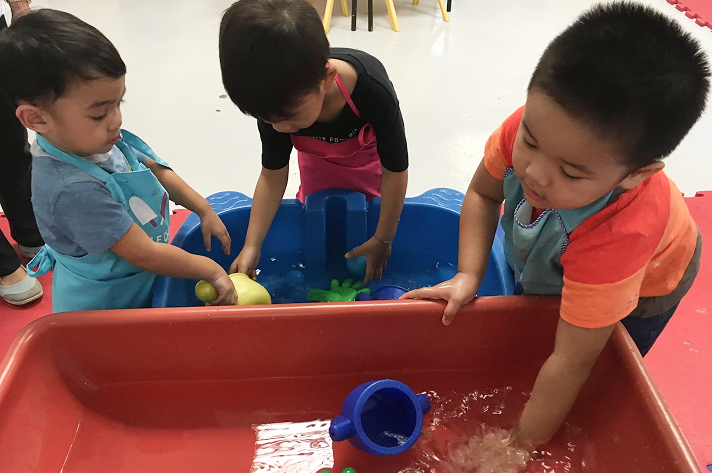
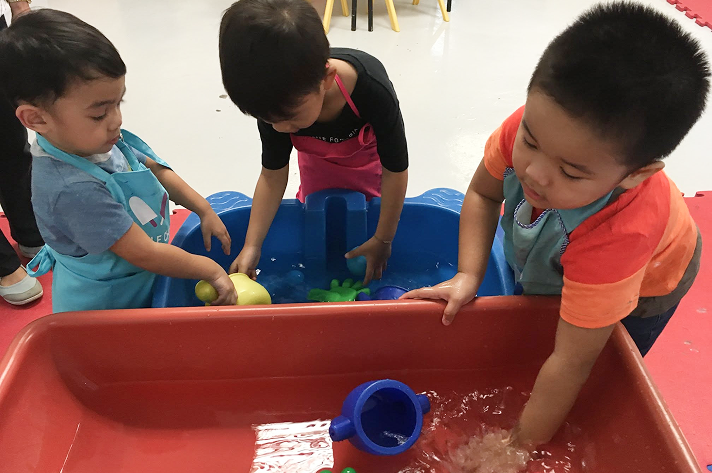
Sensory activities help children to be curious and observant. These activities encourage language development by inviting them to describe what they feel, hear, and see. Water, sand, and play dough can be used to explore materials and develop fine motor skills. Provide a range of objects for children to use as tools for scooping, pouring, and comparing. Set up inviting challenges such as “Which container can hold the most water?” or “Can you make a pattern with smooth and bumpy textures?” Provide a variety of tools that children can use to explore the materials.
8. Role-play and dress-up
Role-play encourages children to use their imaginations and can support language development, collaboration, and confidence-building. Children can create their own stories and act them out using dressing-up items and simple props. They might run a pretend shop, complete with self-printed price tags and a cash register. Encourage children to think of ways to help each other, such as by taking a message to another “shop”. You could scaffold the activity by adding a few words or items related to the role-play scenario. If children get into a disagreement, you might prompt them to think of a solution such as taking turns. Role-play scenarios offer countless opportunities for learning and collaboration.
9. Building, construction, and puzzles
Construction activities such as building with blocks and completing jigsaw puzzles help to develop spatial awareness, coordination, and perseverance. Challenges such as “Can you make a bridge for this toy?” encourage children to think through a problem. Ask children to explain what they have built or how they solved the challenge. If there is an issue with the way something is constructed, ask questions such as “What happens if the toy goes over the bridge?” or “How can we make the bridge stronger?” rather than telling them how to fix it. These preschool activities can be adapted to a range of developmental levels: a young child might complete a simple four-piece puzzle while an older child tackles something more challenging.
10. Nature and outdoor learning activities
Exploration in nature offers numerous opportunities for discovery and discussion. Children can notice and talk about the weather, observe different types of leaves, and look for animal tracks and other signs of wildlife. They can create patterns with sticks and stones and complete simple challenges such as an obstacle course. In Metro Manila, outdoor play requires careful planning due to temperature and air quality concerns. Outdoor activities may need to be cancelled or rescheduled on particularly hot, rainy, or polluted days. If the weather is unsuitable for being outside, indoor alternatives can be planned. Children can observe and discuss leaves, flowers, and other natural materials, or bring these items indoors so that students can handle and investigate them more closely. The key to these fun activities for preschoolers is to make observations and ask questions, not to travel great distances.
How to Choose Age-Appropriate Classroom Activities
An age-appropriate activity is one in which the materials, language, and challenge are suitable for the students’ developmental levels. Children of the same age vary greatly in terms of interests, abilities, and sensory and language needs.
Using this simple planning frame can help to ensure that activities have a strong educational purpose, are accessible to all children, and offer opportunities for independent choice and decision-making:
Check what the teacher considers to think about this example goal what is the main learning aim? Comparing amounts rather than simply completing a worksheet access Can all children understand and engage with the activity? Using larger numbers, pictorial instructions, or a demo for younger children or those with additional needs. Choice Is there an opportunity for children to make decisions or have some independence? Having a choice of materials to sort and how to sort them: observe What will show what the children have learned or understood? Listening to children explain their thinking and what they did
Activities should be easy to access but have the potential to offer challenge and extension. One child might complete a jigsaw puzzle with four pieces while another attempts one with more. Both can develop spatial awareness and perseverance. Another helpful tip for choosing preschool activities is to balance independent, paired, and group work, rather than always working in one format.
How Can Teachers Make Preschool Activities More Engaging?
Children will be more engaged in an activity if they can interact with materials, make decisions, and feel that their efforts have value. Clear boundaries and expectations are still necessary, but children can make choices within those limits. Teachers can
- use real objects, pictures, actions, and words to explain an activity,
- keep instructions simple and model the task first,
- make connections to stories, routines, or experiences that children already know,
- offer choices of materials, roles, and responses,
- build in opportunities for quiet, focused work as well as active and social tasks,
- ask open questions such as “What else can you do with this?” rather than giving away answers,
- observe children and think about when to offer help, challenge, or reassurance,and recognise that repetition is often a valuable part of learning for young students.
While worksheets can be useful tools, learning activities for preschoolers should not be overly dependent on such resources. Parents who are researching international preschools in Metro Manila might want to ask educators how they balance child-initiated and guided play and how learning is captured and shared with families.
What Skills Do Preschool Classroom Activities Develop?
The most developmentally appropriate activities often have multiple aims and allow children to learn and practice a range of skills.
Developmental area skills Examples of activities
Cognitive Memory: attention, reasoning, problem-solving, and early maths skills Sorting objects in different ways
Language Listening: vocabulary, speaking, storytelling, and conversation; retelling a picture-book story with puppets
Motor Hand-eye coordination: fine motor skills and balance, making shapes with modelling clay or following an obstacle-course challenge
Social-emotional Sharing: cooperation, turn-taking, self-regulation, and confidence acting out a scenario in a role-play shop
Creative Imagination and experimentation: Building a structure with blocks or making a collage
According to research from the Centre on the Developing Child at Harvard University, playful activities can help students to develop attention, working memory, and impulse control, all of which are important executive functioning skills. These abilities help children to follow instructions, complete tasks, and manage their behaviour and emotions in groups.
How to Create a Balanced Learning Routine for Preschoolers
A balanced routine provides young students with predictability and security while allowing for flexibility and student choice. It might include opportunities for well-being activities and storytelling, as well as learning-centre time, creative activities, and outdoor play. The daily schedule should be based on the needs of the students as well as the requirements and constraints of the school setting.
Rather than focusing on the number of activities per day, teachers can aim to maximise the quality of children’s engagement. Has the class had sufficient time to immerse themselves in an activity? Have the students been able to talk through their ideas and decisions? Have they had the opportunity to move, create, and explore, as well as to sit and listen? Has the balance between social and independent work been appropriate?
Educators can also use observations to plan future activities. If students spend a significant amount of time outside comparing the size of leaves and talking about their observations, the class could revisit the topic in the classroom by sorting the leaves or drawing them. This way, learning and play can be integrated seamlessly throughout the preschool day, covering language, early maths, science, creative expression, and social-emotional development.
A Quick Classroom-Activity Checklist
Before introducing a new activity, ask yourself the following questions:
• Does the activity have a clear educational purpose?
• Are the materials developmentally appropriate and free from potential hazards?
• Are small objects used responsibly to avoid choking hazards?
• Can the instructions be demonstrated clearly and concisely?
• Can the children make choices or decisions during the activity?
• Can the activity be modified to accommodate different students’ needs?
• Is participation encouraged across languages, sensory channels, and developmental levels?
• Is there sufficient time for uninterrupted engagement and clean-up?
Questions to Ask Preschool Educators During a School Tour
- When parents are touring schools for preschool, they may find these questions more informative than general ones about activities:
- How do you manage the tension between guided instruction and child-initiated exploration?
- How do you modify activities for students with diverse developmental, language, and sensory needs?
- How do you capture children’s learning during play and share this with families?
- How much time do students have for unstructured outdoor free play?
- How do you integrate storytelling, early maths, art-making, music, and inquiry into the curriculum?
- What health and safety policies do you have regarding sensory materials, outdoor play, and small objects?
Conclusion
The most effective early-years activities are not necessarily complicated. Story discussions, sorting games, and role-play scenarios all have the potential to become rich learning experiences if children are encouraged to observe, make choices, explain their decisions, collaborate, and try new approaches. By combining guided and independent learning, educators can support language development, early numeracy and science skills, creative expression, motor development, and social-emotional growth in young children. Parents who are considering DIS for their child should review the school’s current early-years programme page and ask how these principles are demonstrated in classroom practice.