

Welcome to Domuschola International School

Best Elementary School in Pasig City, Metro Manila

Learning at DIS

Primary Years
Programme

Our Programme

Primary Years Programme

At DIS, we offer the International Baccalaureate (IB) PYP for students from Kindergarten to Grade 5. This internationally recognised curriculum framework is designed for children aged 3 to 12 years and serves as a strong foundation for the IB Diploma Programme, which culminates at the age of 19. Our PYP curriculum is valued by universities both locally and globally.

our Approach

Why Choose the PYP at
Domuschola International School?

Globally Recognised IB Curriculum
Focus on the Whole Child
Dynamic Inquiry-Based Learning
Emphasis on Action and Social Responsibility
Preparation for Lifelong Learning and Future Success
Our Approach

A Holistic Approach to Learning

The PYP at Domuschola focuses on the total growth and development of young learners, nurturing their hearts and minds. Our program addresses not only academic growth but also the social, physical, emotional, and cultural needs of each child. We believe that education extends beyond acquiring knowledge—it also involves developing positive attitudes, essential life skills, and a strong sense of social responsibility.

The Methodology

Inquiry-Based Curriculum Framework

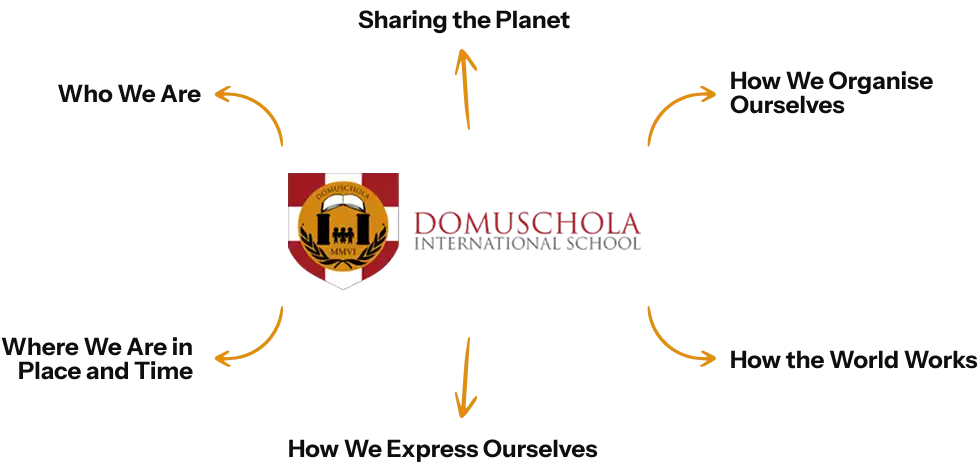
The PYP curriculum is built around six transdisciplinary themes, creating a dynamic and engaging learning environment:

Each theme is explored through carefully planned units of inquiry. Our dedicated teachers use a wide range of resources and teaching strategies to help students develop multiple perspectives and a deeper understanding of the world around them.

Inquiry-based Learning

Inquiry as the Heart of Learning

At DIS, inquiry-based learning is at the core of our educational philosophy. We view our students as natural thinkers and active participants in their learning journeys. Instead of simply receiving information, our students are guided to:

This approach empowers our students to become lifelong learners, ready to adapt and thrive in a constantly changing world.

FAQ

Frequently Asked Questions

What is the Primary Years Programme?

The Primary Years Programme (PYP) is a curriculum framework for young learners aged 3-12 designed by the International Baccalaureate (IB). Founded on a philosophy that recognizes a child’s natural curiosity, creativity and ability to reflect, the PYP generates a stimulating, challenging learning environment to nurture those assets and foster a lifelong love of learning in every child. The PYP, like all IB programmes, is transdis-ciplinary, meaning students learn across subject areas while investigating big ideas.

In the PYP, students learn about significant concepts through units of inquiry. The six transdisciplinary themes that guide units of inquiry and compose a year of study are:

  • Who we are
  • Where we are in place and time
  • How we express ourselves
  • How the world works
  • How we organize ourselves
  • Sharing the planet.

Units of inquiry interweave subject areas such as mathematics, language arts, science and social studies.

This approach encourages students to make their own connections between what they lear in core subject areas and how it relates to the world around them.

The school outlines its specific knowledge content and academic curriculum, guided by the following five essential elements:

  • The knowledge content is organized under the transdisciplinary themes. Each school decides which specific topics to study under each theme.
  • The learning skills aim to help students become in-dependent, well-functioning, self-motivated learners.
  • The learning attitudes aim to develop a lifelong love of learning and nurture a child’s curiosity and confi-dence.
  • The action component emphasizes the need to connect the student with his or her own potential and responsibility for using what was learned.
  • The rigorous guidelines for classroom practices to match the educational philosophy and values of the IB are communicated through professional development and a school’s internal reflection process.
  • IB World Schools (the only schools authorized to offer IB programmes) are subject to a strict accreditation process monitored by the IB, ensuring that schools provide a high-quality education.
  • IB teaching methods and curriculums are re-search-based and draw from the best educational practices from systems around the world.
  • IB teachers are required to participate in many professional development opportunities to continually promote their awareness of current educational practices and new thinking.
  • IB students develop a sense of the world around them and their responsibility to it.
  • IB programmes are recognized internationally and ease the educational transitions of mobile students so that their education is not adversely affected if their families relocate.

All PYP teachers receive professional development in IB’s approaches to teaching and approaches to learning from certified IB workshop leaders. This is a requirement for IB World Schools implementing the PYP.

The PYP is implemented schoolwide and adapted by teachers to meet the learning needs of all students. In most cases, the Middle Years Programme (MYP) is also a schoolwide program. All PYP teachers are required to participate in collaborative planning and reflection to make their teaching practices consistent and to foster a holistic approach to education. A growing body of evidence suggests a positive relationship between teacher collaboration and student achievement.

The IB is committed to making sure that students in IB programmes meet and exceed local or national stand-ards. With the implementation of any IB programme, schools are required to examine their curriculum carefully to ensure that there is alignment with local, state or national standards. More information on the IB and the Common Core is available at www.ibo.org.

The IB places great value on external validation of its programmes, curriculums and professional develop-ment. A recent Global International Schools Assessment| study found that PYP students outperformed non-IB students in mathematics, reading and writing. Additional studies on programme impact, quality assurance, programme development and assessment research are available at www.ibo.org/research.

  • Visit the IB website at www.ibo.org
  • Attend school meetings and events
  • Speak with your school’s PYP coordinator
  • Speak with your childs PYP classroom teacher.

Nurturing Young Minds For a Bright Future

Primary Years Programme nurtures young minds for a bright future, inspiring a lifelong love for learning and empowering them to make a difference!