
key takeaways
- Maths activities for preschoolers work best when they’re disguised as play puzzles, songs, and games build number sense without feeling like a “lesson,” helping kids form a positive relationship with maths early on.
- Number activities for preschoolers don’t need special equipment everyday items like cups, candy, cubes, and grocery items are enough to teach counting, sorting, and comparison.
- Early maths activities work best when they combine a physical or sensory element (touch, movement, sorting) with a numeracy skill, since that’s how young children learn most effectively.
- Simple math games for kindergarten and preschool like counting steps outdoors or hunting for numbers in a sensory bin can be done indoors or outside, making them easy to fit into daily routines.
- Repeated, playful exposure through educational math games and preschool math games builds stronger mathematical confidence at this age than formal instruction, and helps prevent maths anxiety later in school.
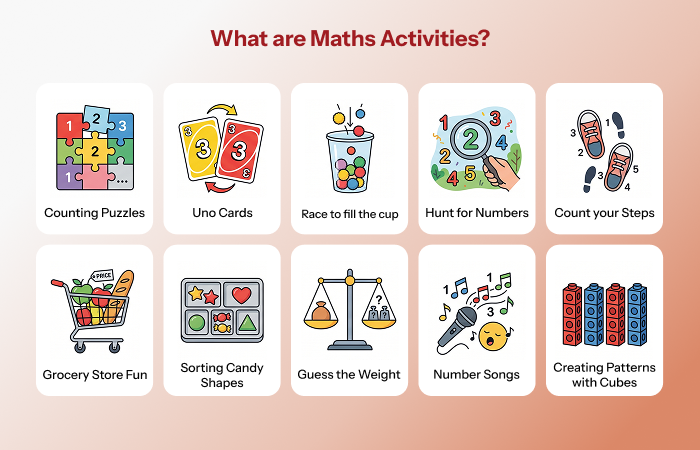
What are Maths Activities?
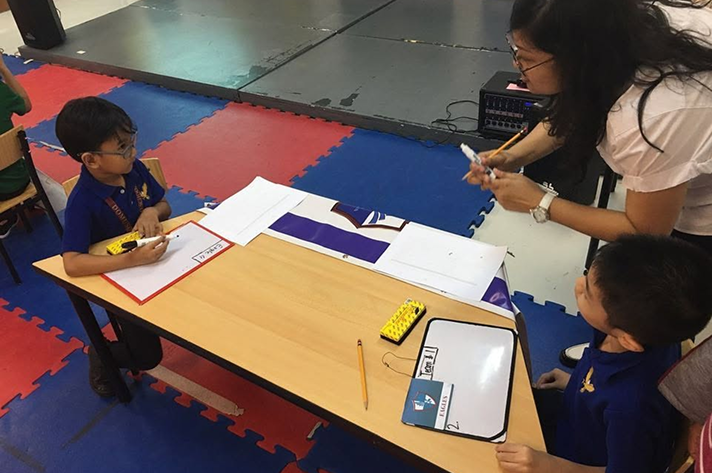
Maths activities are interactive tasks that help students understand mathematical concepts through practice, problem-solving, and real-life application, making learning engaging while strengthening logical reasoning and analytical thinking skills.
1. Counting Puzzles
Counting puzzles are one of the most effective maths activities for preschoolers. Making the children solve them is known to help develop their cognitive ability. The way to solve them is to follow a predefined set of rules. This generally involves understanding a pattern to be followed and then attempting to solve the puzzle, getting acquainted with the numbers and counting in the process.. The more practice one gets at this, the better a child becomes.
2. Flip Uno Cards to Make a Match
Uno cards lend themselves beautifully to make the kids play number matching games that help with number recognition. This game can be played by flipping the uno cards in a manner that a child is unable to see the numbers.One can take turns picking two cards. If one makes a match one keeps the set and follows that up by taking another turn. Whoever has the most sets to their credit are the winners.
3. Race to Fill the Cup
This is a simple, yet effective game to get children to know and understand numbers. One can play this game with the help of a few plastic cups and a collection of small objects like paper clips, pennies or buttons. One can roll a die and get the kids to fill their cups with the number chosen objects corresponding to the number obtained as soon as they can. The child who fills up his or her cup the fastest wins.
4. Hunt for Numbers
This game involves the children trying to find specific numbered cards in a sensory bin which contains materials like dry pasta, sand, rice and popcorn kernels. Once collected these cards can be placed onto a key in the shape of numbers written on pieces of card.
5. Count your Steps
Taking the kids outdoors and making them count the number of steps walked is another wonderful way of making them understand the concept of numbers and counting. They could ,for instance, be asked to count the number of steps they took, when walking across the garden.
6. Grocery Store Fun
You can make a trip to the grocery store, a fun activity for your preschooler. You can have them count the number of grocery items that can fit into a bag. Alternatively you could ask them to find out which of the two items you have in your hands is heavier.

7. Sorting Candy Shapes
Nothing entices a little child more to do something than getting rewarded by tasty candy in return for something they are asked to do. You can help them learn numbers by getting them to place different types of candy kept in a bowl into separate bunches according to their size, shape and colour and then go on to count the number of candies in each group.
8. Guess the Weight
This is a great way of helping children understand the concept of measurement, especially with regard to weight.They can be instructed to arrive at a guess with regard to things lying in their homes. This could be anything from onions and potatoes to toys and combs. They could also be asked to compare weights and guess which objects are heavier than others.
9. Number Songs
Number songs are a very old and classic way of teaching little children about numbers. The use of catchy tunes to make the lyrics appealing helps reinforce the message pertaining to the numbers to be learned in a very effective manner indeed.
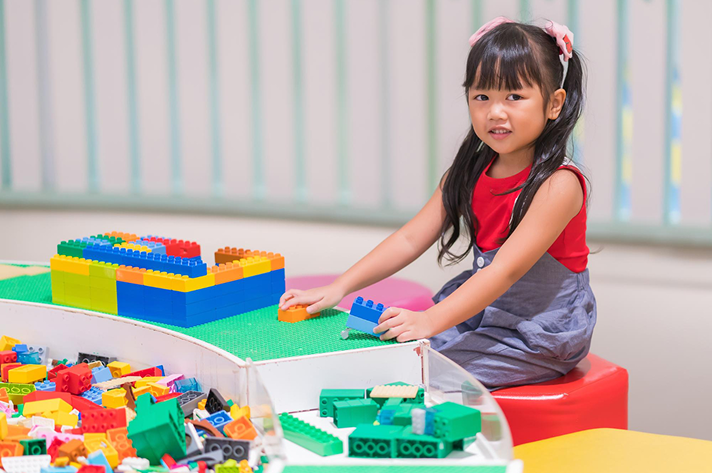
10. Creating Patterns with Cubes
Encouraging children to create patterns with cubes is a proven method of empowering them to learn about numbers and maths. They could, for instance, be asked to use differently coloured cubes to create colour patterns encouraging them to experiment with patterns of their own. This will inculcate the concept of sequences as well as problem solving in the kids-bohb essential components of maths.
Conclusion
Getting preschoolers interested in maths is the best gift that you can give to the little ones. The activities described in this article are some of the best ones that there are to get little ones interested in maths. The key here is to make the activities fun so that the children feel that they are playing rather than receiving a heavy maths lesson. It is important that children from an early age associate maths with fun, so that they do not develop any phobia for the subject, which is quite often the case with many children.Getting preschoolers interested in maths is the best gift that you can give to the little ones. The activities described in this article are some of the best ones that there are to get little ones interested in maths. The key here is to make the activities fun so that the children feel that they are playing rather than receiving a heavy maths lesson. It is important that children from an early age associate maths with fun, so that they do not develop any phobia for the subject, which is quite often the case with many children.
FAQs
1. What are the best maths activities for preschoolers?
Some of the best maths activities for preschoolers include counting puzzles, number hunts in sensory bins, sorting candy by shape and size, and creating patterns with cubes. These activities work well because they combine hands-on play with basic numeracy skills, helping children learn without feeling like they’re being taught a formal lesson.
2. Why are early maths activities important for young children?
Early maths activities help children build a strong foundation in logical reasoning, counting, and problem-solving before they enter formal schooling. Introducing numbers through play at a young age also helps children develop a positive association with maths, reducing the chances of maths anxiety later in their academic life.
3. What are some simple math games for kindergarten that parents can try at home?
Simple math games for kindergarten don’t require any special tools. Activities like “Race to Fill the Cup,” counting steps on a walk, or playing matching games with Uno cards can all be done at home using everyday objects, making them easy for parents to incorporate into daily routines.
4. How do number activities for preschoolers help with learning?
Number activities for preschoolers help children connect abstract numbers to real, tangible experiences like counting grocery items or guessing the weight of objects. This hands-on approach strengthens number recognition and comparison skills while keeping children engaged and curious about maths.