

key takeaways
- Global recognition drives the shift. One of the biggest benefits of IB education is its international credibility universities in the US, UK, Canada, and Australia hold the international baccalaureate curriculum in high regard, with many offering credit or advanced standing for strong IB scores.
- The IB curriculum builds independent thinkers. Through components like the Extended Essay and Theory of Knowledge, the ib curriculum pushes students beyond rote memorisation into genuine inquiry-based learning one of the core ib curriculum benefits that sets it apart from traditional systems.
- Time management becomes a life skill. The rigour of the international baccalaureate curriculum naturally teaches students to balance workloads and meet deadlines, a discipline that carries well beyond graduation into university and professional life.
- Holistic development is central, not optional. Unlike grade-focused systems, the ib curriculum is built around the IB learner profile values like being principled, reflective, and open-minded making global citizenship education a built-in part of the student experience rather than an add-on.
- Students are prepared for real-world complexity. Through collaborative projects, multicultural perspectives, and service learning, the benefits of IB education extend into producing self-starters who are ready to engage with global issues a direct outcome of strong global citizenship education.
As the global landscape of education continues to evolve, an increasing number of Filipino families are rethinking traditional approaches and seeking more progressive, globally recognised alternatives. Among these, the International Baccalaureate (IB) curriculum has emerged as a top choice for parents who desire more than just academic achievement for their children. In progressive schools like Domuschola International School, known for its commitment to excellence and innovation, IB education in the Philippines is redefining what it means to prepare learners for a complex, interconnected world. For families exploring world-class education in the Philippines, the IB pathway offers a compelling, future-ready option.
What is the International Baccalaureate?
The International Baccalaureate (IB) is a globally recognised educational framework that aims to develop enquiring, knowledgeable, and caring young people. It offers four programmes catering to students aged 3 to 19, with the most well-known being the IB programme—specifically, the IB Diploma Programme (IBDP) for Grades 11 and 12. Unlike rigid traditional curricula, IB learning emphasises conceptual understanding, international-mindedness, and the holistic development of students.
With more than 5,000 schools in over 150 countries adopting the IB curriculum, the programme is revered for its academic rigour, emphasis on critical thinking, and cultivation of real-world skills. Domuschola International School, an accredited IB World School in the Philippines, stands out for its successful implementation of this globally benchmarked education model.
Reasons for Considering IB Education
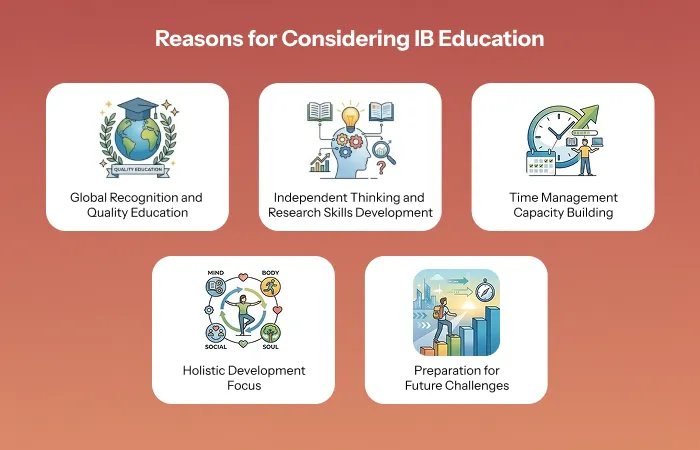
So, why are more parents in the Philippines making the shift toward IB schools like Domuschola? It comes down to a deep alignment between what the IB curriculum offers and what modern families are looking for: a values-based education that prepares students not only for college but also for life.
1. Global Recognition and Quality Education
One of the most compelling reasons parents choose IB education in the Philippines is its international credibility. Universities worldwide—particularly in the United States, the United Kingdom, Canada, and Australia—hold the IB Diploma in high regard. Many even offer advanced standing or course credit for strong IB scores.
But beyond just university admissions, the IB ensures high academic standards and a curriculum that fosters deep understanding rather than rote memorisation. Subjects like Theory of Knowledge (TOK), Extended Essay (EE), and Creativity, Activity, Service (CAS) set the IB apart from traditional systems, challenging students to apply knowledge in meaningful ways.
Domuschola’s IB programme delivers these components effectively, offering students a clear advantage when applying to top global institutions and elevating the standard for education in the Philippines.
2. Independent Thinking and Research Skills Development
The IB’s inquiry-based approach actively encourages students to question, explore, and challenge ideas. Instead of merely consuming content, learners construct their understanding through interdisciplinary connections and authentic experiences—hallmarks of IB learning.
Students develop strong research and analytical skills through assignments like the Extended Essay, a 4,000-word independent research project that rivals pre-university work. This not only builds academic confidence but also nurtures a genuine love for learning.
At Domuschola International School, students are constantly exposed to research-based learning methodologies that foster curiosity and intellectual autonomy, key traits for success in the 21st century. While the International Baccalaureate (IB) programme can initially feel overwhelming for some students due to its academic rigour and emphasis on independent inquiry, Domuschola provides thoughtful and personalised support during this transition. Through mentoring, scaffolded learning experiences, and a nurturing academic environment, the school ensures that students gradually build the confidence and skills needed to thrive in the IB framework.
3. Time Management Capacity Building
Managing the demands of the IB curriculum naturally teaches students how to balance workloads, prioritise tasks, and meet deadlines. These time management skills are invaluable, not only for university success but also for personal and professional life later on.
Domuschola’s supportive environment helps learners navigate these challenges constructively. Teachers mentor students in organising their time effectively, allowing them to thrive even under academic pressure. This kind of training fosters resilience and discipline—attributes that serve students well beyond the classroom and make a meaningful difference to education in the Philippines.
4. Holistic Development Focus
Unlike traditional education systems that often emphasise grades above all, IB education prioritises the development of the whole child. The IB learner profile outlines attributes such as being principled, open-minded, balanced, and reflective, instilling values that promote emotional intelligence and global citizenship.
Subjects like CAS (Creativity, Activity, Service) ensure students engage in co-curricular activities that develop empathy, leadership, and community involvement. Domuschola effectively integrates these experiences into its school culture, providing students with opportunities to develop into well-rounded individuals with a strong sense of purpose and identity. In early and primary years, this whole-child approach aligns well with frameworks like the international primary curriculum, supporting continuity and coherence in a learner’s journey.
5. Preparation for Future Challenges
The modern world is dynamic, diverse, and filled with uncertainty. The IB curriculum recognises this reality and is built to equip students with the skills and mindset needed to navigate complexity, solve real-world problems, and adapt quickly to change.
From interdisciplinary learning to collaborative group projects and multicultural perspectives, IB students emerge as critical thinkers, effective communicators, and global leaders. At Domuschola, this preparation is evident in how students are encouraged to engage with local and international issues through service learning and global awareness projects.
Graduates of IB education programmes are often described as self-starters who are intellectually curious, ethically grounded, and ready to make meaningful contributions in any field they pursue.
Conclusion
The rising preference for IB education in the Philippines signals a broader shift in parental priorities—from academic performance alone to holistic growth, global readiness, and future-proof skills. At institutions like Domuschola International School, the IB curriculum is not just a set of subjects—it’s a philosophy that nurtures learners who are thoughtful, capable, and prepared for the challenges of tomorrow.
For families seeking a transformative learning experience rooted in academic excellence, values-based teaching, and international standards, the IB is an investment in their child’s future—and Domuschola is leading the way in making that future bright through its IB programme and alignment with the international primary curriculum.
FAQ’s
1. What are the main benefits of IB education?
The benefits of IB education include global university recognition, strong research and critical-thinking skills, better time management, and a holistic approach to student development. The ib curriculum benefits go beyond academics, shaping well-rounded, globally aware learners.
2. What makes the international baccalaureate curriculum different from other systems?
The international baccalaureate curriculum focuses on conceptual understanding and inquiry-based learning rather than memorisation. Unlike traditional systems, the ib curriculum integrates components like the Extended Essay and CAS (Creativity, Activity, Service) to build independent, well-rounded thinkers.
3. How does the IB curriculum support global citizenship education?
The ib curriculum embeds global citizenship education directly into its learner profile, encouraging students to be open-minded, principled, and engaged with international issues. Programmes like CAS and service learning give students real opportunities to practice empathy and leadership on a global scale.
4. Is the international baccalaureate curriculum worth it for university preparation?
Yes one of the strongest ib curriculum benefits is how well it prepares students for university. The international baccalaureate curriculum is respected by top institutions worldwide, and many universities offer credit for high IB scores, making it a strong long-term investment in a child’s academic future.